
Two thirds of FutComp's traffic came from ChatGPT. Here's what we did.
In its first full month, FutComp got 1,100 of its 1,700 new users from AI assistants and 86 from Google. This is what we did to the site to earn that, what the numbers do and don't prove, and how much of it transfers to ordinary client work.
We launched FutComp in the middle of October 2026 and built it, deliberately, to be easy for an AI assistant to read and quote. The case study covers what the site does. This post is about where its visitors came from.
The numbers
Google Analytics, 4–31 October 2026, the site’s first full month:
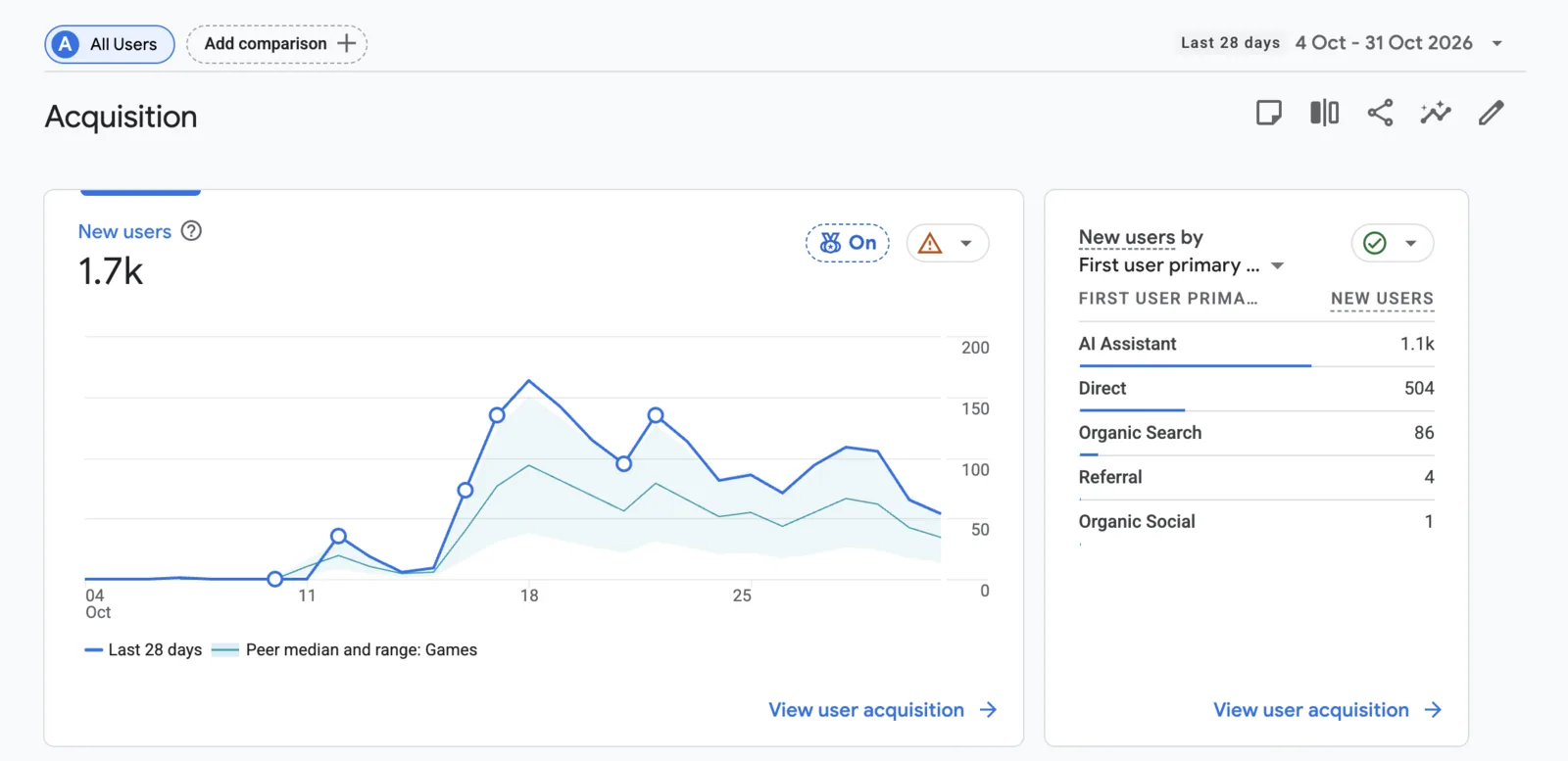
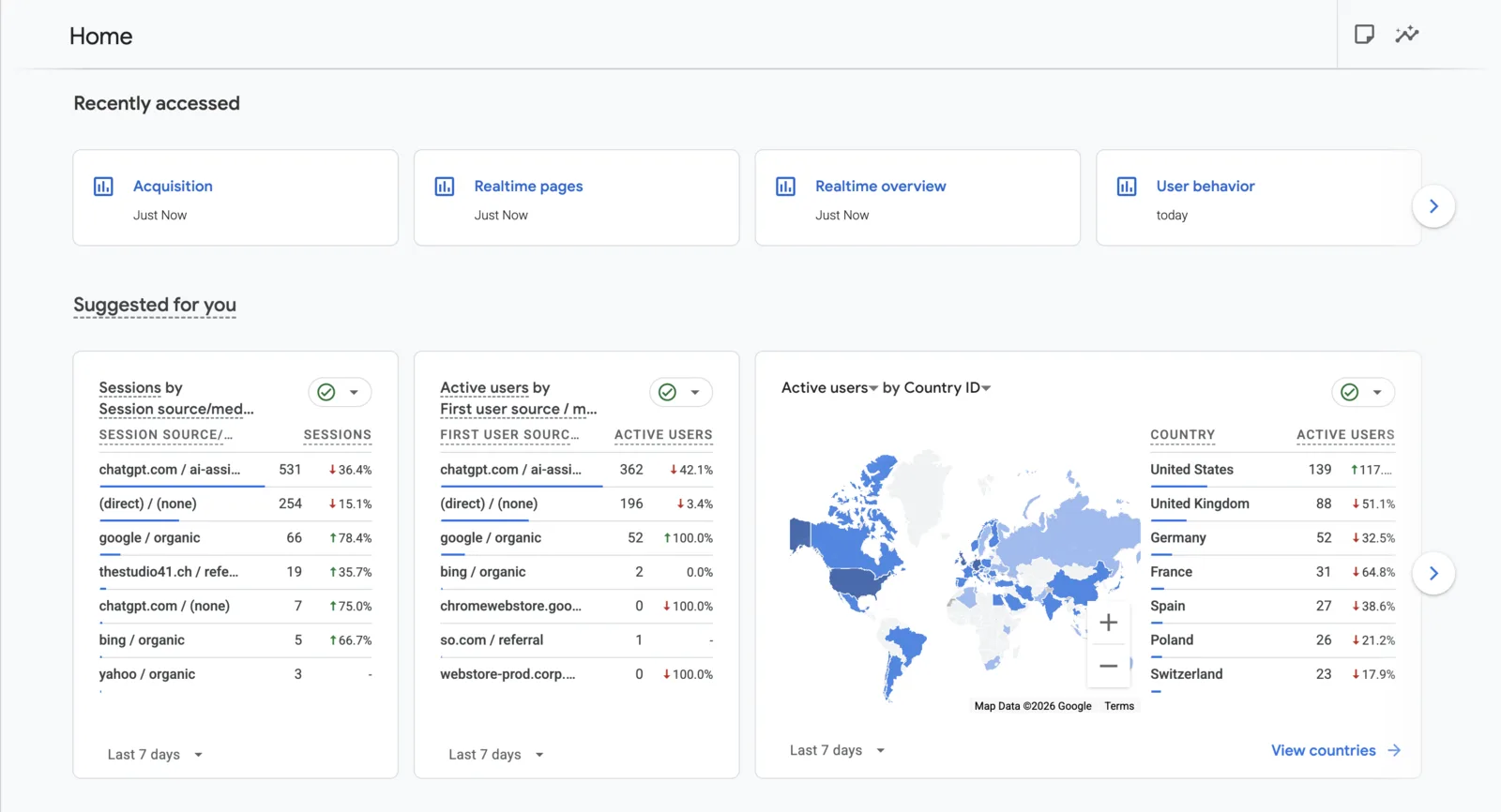
Of 1,700 new users, about 1,100 arrived from an AI assistant and 86 from a search engine. Broken down by source, over a single week, the picture is the same: ChatGPT sends more than twice what direct does, and roughly eight times what Google does.
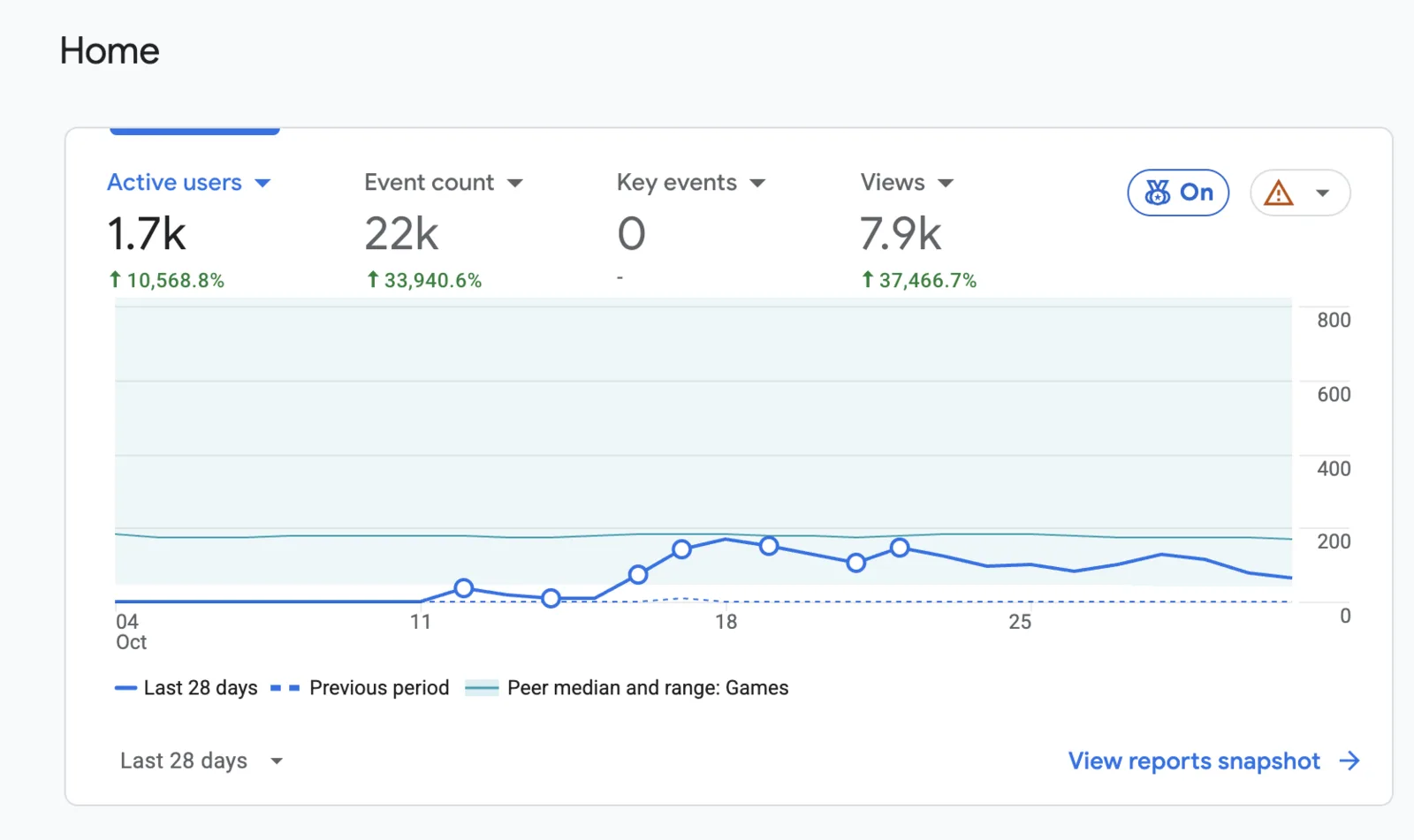
Over the month that came to 22,000 events and 7,900 page views.
What this doesn’t prove
Three honest caveats before anyone copies the homework:
- It’s a new site. The eye-watering percentage increases compare October against a month when FutComp wasn’t live. Treat them as noise.
- Direct isn’t clean. Some assistants pass no referrer, so a share of those 504 direct users are probably AI traffic too. Others are the installed app and the Chrome extension coming back.
- No conversion data. Key events read zero, because FutComp is free, account-free and has nothing to convert. We can tell you people arrived. We can’t yet tell you what they were worth.
What the split does show, clearly, is that for a brand-new site in a crowded niche, an assistant will quote you long before Google ranks you. Google needs months of authority signals. ChatGPT needed a page it could read.
The shift
The useful mental model: an assistant isn’t ranking pages, it’s choosing sources to quote. A ranked list of ten blue links rewards authority. A single synthesised answer rewards whichever page states the fact most clearly and most verifiably. So the job changes from “rank for a keyword” to “be the clearest answer”.
Most of what follows is just good SEO applied more strictly. That’s the point — it isn’t a separate discipline, and anyone selling you “GEO” as a new product is mostly selling you the basics.
What we actually did
Let the AI in
A surprising number of sites block AI crawlers without realising it — it’s a default in some CDNs, security plugins and WordPress SEO settings. We allow them on purpose, in robots.txt.
It pays to know which crawler is which, because they do different jobs: one fetches a page live to answer the question in front of it, another gathers training data, another builds a search index. You can welcome the ones that cite you and still refuse the ones that don’t, and that decision is yours to make rather than your plugin’s.
Tell it who you are
FutComp publishes an llms.txt — a plain-English summary of the site written for machines. Think of it as a cover letter: what this site is, what it does, where the important pages live. It costs an hour and removes any need for a crawler to guess.
Make the page readable
- The content is in the HTML. FutComp’s pages are rendered on the server. If the text only appears after a JavaScript framework boots, a crawler may never see it. This single decision does more than everything else on this list.
- Structured data. Schema.org markup is a backstage label saying this is a question, this is its answer, this is a software application, this is the price. It turns prose into facts a machine can lift without inferring.
- Clear headings, answers near the top. Every page leads with its conclusion and puts the detail underneath.
Answer real questions
People type whole questions at an assistant, not keywords. So the copy is written the way people actually ask — what’s the cheapest card with the same stats, not cheap FC 27 cards.
The important part: each answer has to stand on its own. An assistant lifts a passage, not a page. If your paragraph only makes sense after reading the two above it, it won’t survive the trip. A well-written FAQ does far more work than it did five years ago.
Be the original source
This is the one that actually separates sites. An assistant has already read every piece of generic advice ever published. What it cannot get anywhere else is your data.
FutComp has roughly 20,000 card pages, each with live prices, real comparisons and community ratings — not a thin template repeated 20,000 times. When someone asks about a specific player, there’s exactly one page on the internet with a current answer, and it’s ours.
If your site is the thousandth page explaining the same concept, no amount of markup will save you. If it holds something nobody else has, the markup is just making it easy to find.
Stay fresh
Prices change every 30 minutes, pages show when they were last updated, and the sitemap tells crawlers what’s moved so they don’t have to re-read the site to find out. Freshness is a ranking signal for assistants in a way it never quite was for search.
What it’s worth
AI traffic tends to be small in volume but high in intent: the person has already been told you’re the answer, so they arrive halfway convinced rather than comparison-shopping ten tabs. That matches what we see in FutComp’s engagement — 7,900 views and 22,000 events from 1,700 users is a lot of poking about per visitor — but we’d rather you tested it against your own numbers than took it on faith from ours.
The strategic case is simpler. Search traffic is being disintermediated whether anyone likes it or not. You can’t control what an assistant says about you. You can only control how easy you are to read, and how hard you are to replace.
For client work
Almost all of this transfers, and most of it is cheap:
- Check you aren’t blocking AI crawlers. Most sites that are, are by accident.
- Make sure the content is in the HTML before JavaScript runs.
- Add structured data, and an
llms.txt. - Rewrite the key pages as self-contained answers to real questions.
- Find the thing only you can publish — your prices, your data, your results — and publish it properly.
Steps one to four are a few days’ work on most sites. Step five is the hard one, and it’s the one that matters.
If you’d like us to look at where your own traffic is coming from, get in touch.
FutComp is an independent fan project and isn't affiliated with or endorsed by Electronic Arts. EA SPORTS FC, FC 27 and Ultimate Team are trademarks of Electronic Arts Inc.