
Desk: building a non-custodial web3 trading terminal for Polymarket
A cross-platform desktop terminal for Polymarket’s on-chain prediction markets: fast, data-dense, keyboard-driven — and it never touches a user’s funds. Here is how it’s built, and why.
Desk (desktrading.app) is a cross-platform (macOS and Windows) desktop trading terminal for Polymarket’s on-chain prediction markets. It gives serious traders a fast, data-dense, keyboard-driven interface to trade, hedge and manage positions across sports, crypto and event markets — from their own self-custodied wallet, with orders signed on-device and settled on-chain.
It is a non-custodial web3 application: Desk never holds user funds, and the user’s key never leaves their machine. That one constraint shaped almost every engineering decision below.
The stack — and why
Desk is built on Electron (Chromium plus a Node runtime) in TypeScript, structured across Electron’s isolated main, preload and renderer processes and bundled with esbuild. Each layer of that choice is deliberate.
- Desktop, not a web app. Non-custodial trading means the wallet key has to live locally and sign locally. A desktop application is the natural, secure home for a self-custody signer — and it gives traders a persistent, always-on, multi-window workspace a browser tab can’t.
- Electron and Chromium. One TypeScript codebase ships to both macOS and Windows, and Chromium’s mature, GPU-accelerated rendering engine is what lets Desk drive genuinely heavy real-time visualisations — live depth heatmaps, streaming ladders, tick-by-tick charts — without the UI buckling under load.
- The Node runtime. Direct, first-class access to cryptographic signing, WebSocket market-data feeds, worker threads for offloading heavy work, and the filesystem for local key and state handling.
- esbuild. Near-instant bundling of the main, preload, renderer and worker targets keeps the build-and-iterate loop tight.
Order execution and performance
The design goal: end-to-end order latency should be bounded by the exchange round-trip, not by the client.
- Orders are signed on-device and fired as fill-or-kill.
- The real-time market-data feed is parsed on a worker thread, so the firehose never competes with the order and fill path.
- UI updates are frame-coalesced — batched to the display refresh — so a torrent of price ticks renders smoothly instead of thrashing the interface.
- A confirmed-fill model keeps position tracking exact even when fills return thick and fast.
The practical result: Desk stays responsive on order entry and fill confirmation even through Polymarket’s high-churn five-minute crypto markets, where the book updates many times a second.
The trading surfaces
Desk isn’t one view. It’s a set of purpose-built surfaces, each tuned to how a different kind of trader actually works.
The Ladder — for sports and event traders
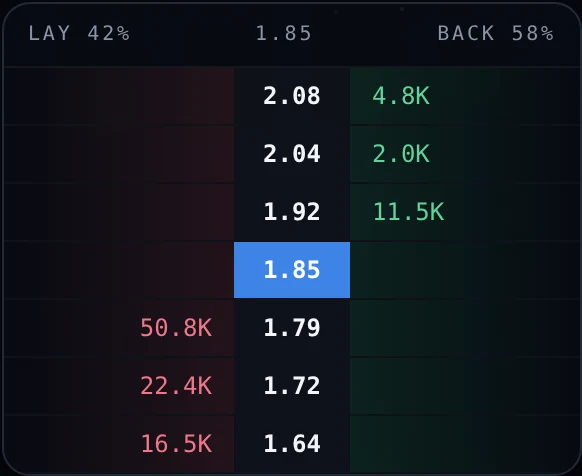
A keyboard-driven price ladder in the vein of professional exchange trading tools, with an adaptive display, a built-in exits engine and a tools panel: one-click position reduction, tick-offset and stop entries, and stake or contract modes. It’s engineered for fast, precise clicks and clean position and hedge readouts, so an in-play sports trader can work a market at speed.
Financial charting — for crypto and financial traders
A live charting surface that renders multiple synchronised price series — multi-venue spot plus reference feeds — as smooth streaming lines alongside candles. It’s the kind of chart a crypto trader expects, built on the real-time feed rather than a static image.
Timed crypto markets
Polymarket’s rapid five-minute “up/down” crypto rounds get dedicated handling, including precise resolution of each round’s strike — the “price to beat” — pinned to the exact on-chain reference: a Chainlink TWAP at the round’s opening second. It’s cache-served, so even a cold open shows the correct level instantly.
Depth and order-flow heatmap
A Bookmap-style depth heatmap — a third crypto view alongside price and odds — that visualises resting liquidity as a colour-graded heat surface, with live best bid/offer tracking, 3D trade bubbles for executed flow, and a full-height consolidated order-book (COB) ladder with a session volume profile (SVP).
Notably, the underlying multi-venue order book is self-assembled from free public Binance and Coinbase WebSocket feeds rather than bought from a paid data vendor — a genuine piece of market-data engineering.
Copy-trading engine
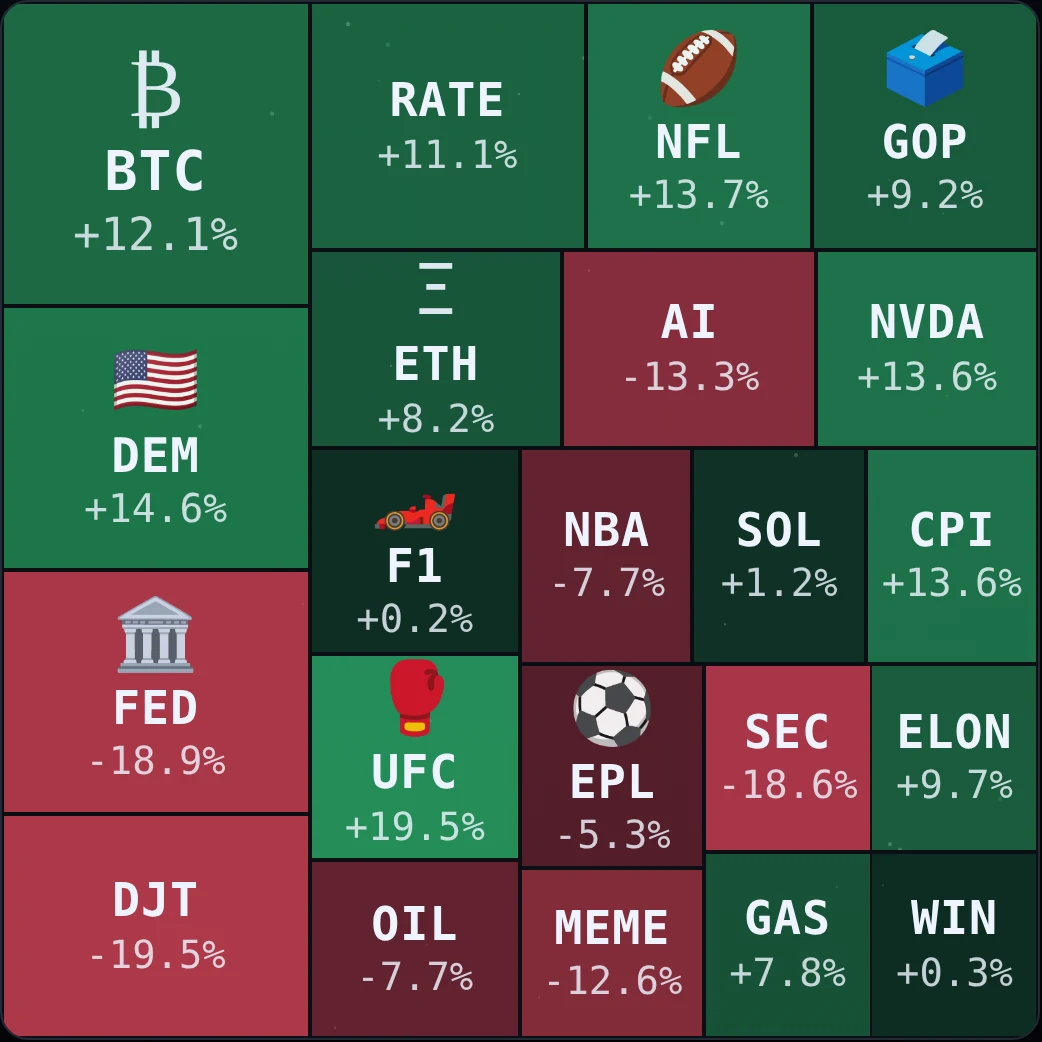
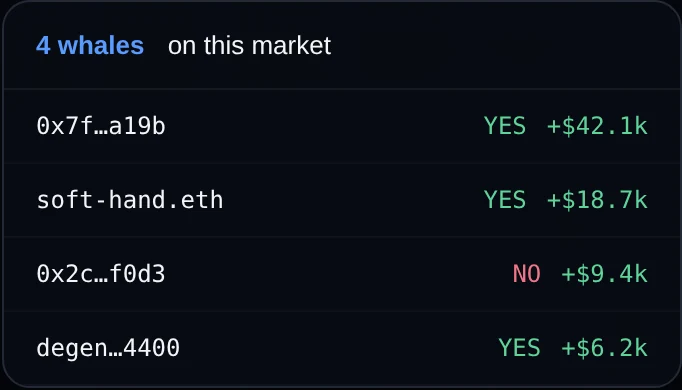
A live copy-trading system that detects a followed wallet’s on-chain activity in real time and mirrors it through a full pipeline — filter → size → slippage gate → fill-or-kill — with configurable rails and safety limits, surfaced from a “smart money” activity rail built on public data.
Sports market tooling
Structured labelling and grouping of sports markets, derived from the venue’s structured fields rather than fragile title parsing, so events, lines and in-play markets present cleanly.
The real-time data layer
Underpinning all of it is a live trade-and-quote feed over WebSockets (Polymarket’s real-time activity and trades stream). The heavy parsing is pushed to a worker thread so market-data volume never delays fills, and a stall watchdog transparently reconnects a dropped feed. This one layer feeds the tape, volume, live pills and every charting surface at once.
Infrastructure and delivery
The supporting infrastructure is intentionally lean and serverless.
- Cloudflare Workers and KV for latency-sensitive edge caches, such as crypto strike levels and a market-detail cache — fast cold loads worldwide, with zero always-on servers.
- A stateless credentials broker that holds only the app’s own builder credentials: no user accounts, no user data, no custody.
- Cloudflare R2 serving signed, auto-updating releases via electron-updater, so installs update themselves over the air.
- A hardened cross-platform build pipeline: esbuild bundle → Apple notarisation for a universal macOS build → Azure Trusted Signing for a signed Windows x64 installer.
Security and the custody model
Desk is trading-only and key-import-only by design. There is no withdraw, sweep, transfer or key-export surface: the app can place orders, but it can never move funds off the wallet.
Trades settle on-chain on Polygon against Polymarket’s CLOB, using EIP-1271 deposit-wallet signing and pUSD collateral. Architecturally it’s the standard modern-DeFi hybrid — off-chain order matching, on-chain custody and settlement — giving exchange-grade speed while the trader stays fully self-custodied.
Engineering highlights
- A cross-platform Electron and TypeScript desktop app with a data-dense, GPU-accelerated real-time UI.
- A worker-thread market-data pipeline plus frame-coalesced rendering, responsive under high-churn markets.
- A self-built multi-venue order book and depth/volume-profile heatmap from free public feeds.
- On-device cryptographic signing, with non-custodial, on-chain settlement.
- A live copy-trading engine with a full detect → filter → size → gate → execute pipeline.
- Serverless edge infrastructure (Cloudflare Workers, KV and R2) plus signed, auto-updating cross-platform builds (Apple notarisation, Azure Trusted Signing).
What it says about how we work
Desk is the kind of project that looks like a user interface and is really a systems problem: latency budgets, threading, cryptography, market microstructure, release engineering. We picked every layer for a reason and can explain each one — which is exactly what we do for every client, whether the brief is a trading terminal, a booking platform or a single, very fast website.
If you have a problem with that kind of depth, we’d like to hear about it.